
Home » The Minerva Difference
The Minerva Difference
Cyber risk programs fail when leaders can’t clearly see what matters, explain their decisions, or sustain progress over time.
Minerva was built to change that — by transforming cyber risk from technical noise into a clear, defensible, and continuously improving management discipline.
Minerva was built to change that — by transforming cyber risk from technical noise into a clear, defensible, and continuously improving management discipline.
Scroll to see how Minerva creates defensible clarity ↓
Why Traditional Approaches Fall Short
Most cybersecurity programs struggle not because teams lack tools or effort — but because traditional models were never built to support leadership decision-making over time.
Point-in-time assessments, compliance-driven tooling, and labor-intensive consulting approaches degrade quickly as conditions change. Visibility fades, priorities drift, and leaders are left making high-stakes decisions without a clear, defensible foundation.
The result is fragmented insight, misaligned investment, and increased exposure when scrutiny arrives.
Point-in-time assessments, compliance-driven tooling, and labor-intensive consulting approaches degrade quickly as conditions change. Visibility fades, priorities drift, and leaders are left making high-stakes decisions without a clear, defensible foundation.
The result is fragmented insight, misaligned investment, and increased exposure when scrutiny arrives.
This is where the Minerva Difference begins.
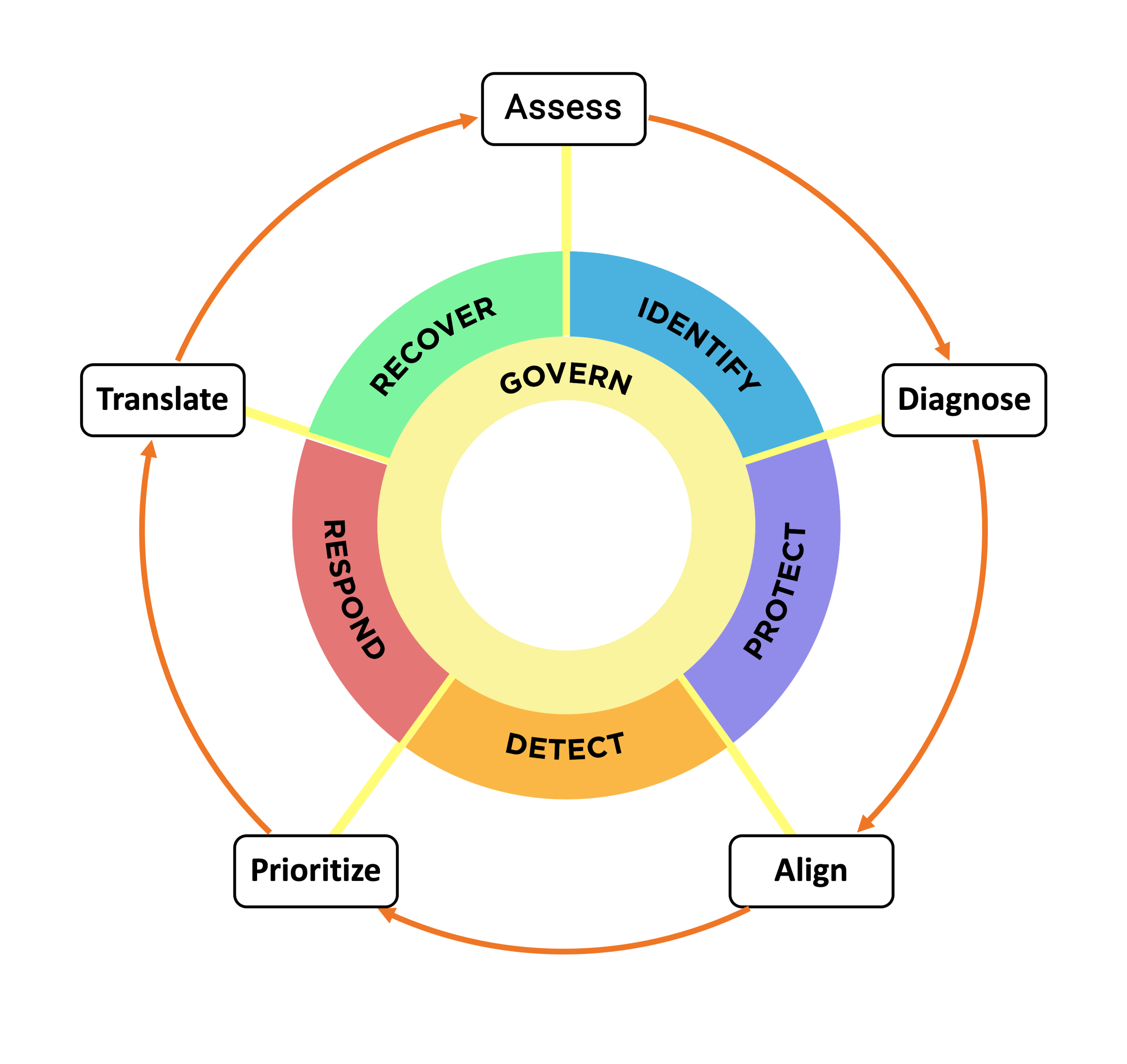
A Different Starting Point: The ADAPT™ Risk Model
The backbone of the Minerva Difference.
Minerva is built on the ADAPT™ Cyber Risk Model — a structured approach designed to help organizations manage cyber risk as a living business discipline, not a one-time compliance exercise.
ADAPT™ reflects how cyber risk actually behaves inside organizations:
Assess — establish an objective baseline
Diagnose — identify the conditions driving risk
Align — connect requirements, resources, and accountability
Prioritize — sequence actions for maximum impact
Translate — make risk understandable and actionable for leadership
ADAPT™ creates a shared language between technical teams and leadership — reducing uncertainty, improving confidence, and enabling defensible decisions over time.
ADAPT™ reflects how cyber risk actually behaves inside organizations:
Assess — establish an objective baseline
Diagnose — identify the conditions driving risk
Align — connect requirements, resources, and accountability
Prioritize — sequence actions for maximum impact
Translate — make risk understandable and actionable for leadership
ADAPT™ creates a shared language between technical teams and leadership — reducing uncertainty, improving confidence, and enabling defensible decisions over time.
How Minerva Operationalizes ADAPT™
Minerva™ turns ADAPT™ into an operational capability.
Rather than static assessments or disconnected tools, Minerva™ provides continuous visibility across people, process, and technology — aligned to established frameworks and regulatory contexts.
Organizations use Minerva™ to:
Rather than static assessments or disconnected tools, Minerva™ provides continuous visibility across people, process, and technology — aligned to established frameworks and regulatory contexts.
Organizations use Minerva™ to:
- Maintain a living risk baseline
- Understand maturity and progress over time
- Identify both acute and systemic risk drivers
- Translate cyber complexity into leadership-ready insight
Assess — Establish a Defensible Baseline
The Assess phase establishes a clear, objective view of the organization’s current cybersecurity posture.
Minerva enables organizations to perform comprehensive assessments aligned to recognized frameworks and regulatory contexts — not as a one-time exercise, but as a living baseline that reflects real operating conditions across people, process, and technology.
Minerva enables organizations to perform comprehensive assessments aligned to recognized frameworks and regulatory contexts — not as a one-time exercise, but as a living baseline that reflects real operating conditions across people, process, and technology.
How Minerva™ Operationalizes Assess
- Conducts structured assessments aligned to industry frameworks and sector-specific requirements
- Centralizes evidence, documentation, and artifacts in a single system of record
- Maintains a dynamic risk register that surfaces gaps often invisible at the leadership level
- Assigns controls and responsibilities in a way that reflects how work actually happens
Why This Matters
Establishing an objective, standards-aligned baseline gives leadership a defensible starting point — replacing assumptions and spreadsheets with evidence that can be explained, measured, and revisited as conditions change.
Diagnose — Identify the Conditions Driving Risk
The Diagnose phase moves beyond surface-level findings to understand why cybersecurity risk exists.
Minerva analyzes control performance, maturity, and context to reveal whether risk stems from operational capability gaps, governance weaknesses, workflow breakdowns, or systemic conditions — not just missing controls.
Minerva analyzes control performance, maturity, and context to reveal whether risk stems from operational capability gaps, governance weaknesses, workflow breakdowns, or systemic conditions — not just missing controls.
How Minerva™ Operationalizes Diagnose
- Benchmarks organizational maturity against peer and industry data
- Analyzes control-level performance to identify patterns and systemic weaknesses
- Distinguishes isolated issues from underlying conditions that drive repeated risk
- Surfaces the most consequential risks based on impact and exposure
Why This Matters
By identifying root causes rather than symptoms, leadership can direct investment toward the conditions that actually reduce risk — improving defensibility, accelerating outcomes, and avoiding wasted effort.
Align — Connect Ownership, Resources, and Accountability
The Align phase ensures that cybersecurity responsibility is clearly defined, appropriately supported, and consistently executed across the organization.
Minerva brings structure to how risk is owned, approved, and addressed — aligning security, IT, operations, and leadership around a shared understanding of responsibility and execution.
Minerva brings structure to how risk is owned, approved, and addressed — aligning security, IT, operations, and leadership around a shared understanding of responsibility and execution.
How Minerva™ Operationalizes Align
- Defines clear risk ownership and authorization paths across technical and non-technical teams
- Aligns cybersecurity activities with existing workflows and operational processes
- Consolidates evidence, artifacts, and approvals into a unified system of record
- Reduces duplicated effort and friction as teams, tools, and priorities evolve
Why This Matters
When ownership and accountability are clear, organizations can govern cyber risk intentionally — demonstrating due care, sustaining progress, and ensuring decisions hold up under internal and external scrutiny.
Prioritize — Focus Effort Where Risk Reduction Matters Most
The Prioritize phase determines what should happen first — and why.
Minerva helps organizations sequence cybersecurity initiatives based on real-world risk, organizational readiness, and expected impact, ensuring limited resources are applied where they deliver the greatest measurable reduction in exposure.
Minerva helps organizations sequence cybersecurity initiatives based on real-world risk, organizational readiness, and expected impact, ensuring limited resources are applied where they deliver the greatest measurable reduction in exposure.
How Minerva™ Operationalizes Prioritize
- Evaluates initiatives based on risk reduction, impact, cost, and operational effort
- Models tradeoffs between competing priorities to support informed decision-making
- Identifies acceptable risk thresholds to guide sequencing and timing
- Produces defensible, data-backed roadmaps leadership can confidently support
Why This Matters
Clear prioritization replaces reactive decision-making with intentional planning — enabling leadership to justify investments, align budgets, and demonstrate that resources are being applied responsibly and effectively.
Translate — Turn Cyber Risk Into Leadership-Supported Action
The Translate phase bridges the gap between cybersecurity execution and leadership oversight.
Minerva™ converts technical activity, risk data, and program progress into clear, meaningful insight that leaders can understand, govern, and confidently support — without requiring deep technical interpretation.
Minerva™ converts technical activity, risk data, and program progress into clear, meaningful insight that leaders can understand, govern, and confidently support — without requiring deep technical interpretation.
How Minerva™ Operationalizes Translate
- Presents risk, progress, and priorities in plain language tailored to leadership audiences
- Delivers consistent reporting and dashboards aligned to organizational risk thresholds
- Reinforces ownership, scope, and accountability across the program
- Tracks progress over time to support continuous improvement and informed investment decisions
Value (Why It Matters)
When cyber risk is clearly communicated and consistently measured, leadership can govern resources responsibly, validate due care, and sustain risk reduction without misalignment or confusion.
Frameworks Without the Rigidity
Frameworks matter — but only when applied in context.
Minerva™ supports recognized industry and regulatory frameworks, including NIST, ISO, CIS, and sector-specific overlays. These frameworks are used as reference points to inform decisions — not as rigid checklists that obscure real risk.
By applying frameworks in this way, organizations can reflect actual operating conditions, avoid false confidence from box-checking, and demonstrate due care without unnecessary complexity.
The result is alignment without distortion — and governance that holds up under scrutiny.
Minerva™ supports recognized industry and regulatory frameworks, including NIST, ISO, CIS, and sector-specific overlays. These frameworks are used as reference points to inform decisions — not as rigid checklists that obscure real risk.
By applying frameworks in this way, organizations can reflect actual operating conditions, avoid false confidence from box-checking, and demonstrate due care without unnecessary complexity.
The result is alignment without distortion — and governance that holds up under scrutiny.




Why This Model Holds Up Under Scrutiny
Minerva was designed for environments where cybersecurity decisions must withstand external and internal scrutiny — not just internal review.
Whether evaluated by boards, regulators, insurers, auditors, or courts, organizations must be able to explain why decisions were made, what evidence supported them, and how risk was managed over time.
Unlike point-in-time assessments or proprietary scoring models, Minerva enables continuous measurement, objective evidence, and comparable progress over time.
This creates defensibility — not just documentation.
Whether evaluated by boards, regulators, insurers, auditors, or courts, organizations must be able to explain why decisions were made, what evidence supported them, and how risk was managed over time.
Unlike point-in-time assessments or proprietary scoring models, Minerva enables continuous measurement, objective evidence, and comparable progress over time.
This creates defensibility — not just documentation.
Our Perspective on Cyber Performance
From our work across regulated and high-accountability environments, we’ve learned that cyber performance improves only when four elements are consistently present: visibility, alignment, prioritization, and translation.
Without them, cyber risk becomes reactive, expensive, and difficult to govern. Decisions drift, investments lose focus, and leadership confidence erodes.
When they are present, cybersecurity becomes a stabilizing force — enabling clearer decisions, stronger governance, and measurable progress over time.
Without them, cyber risk becomes reactive, expensive, and difficult to govern. Decisions drift, investments lose focus, and leadership confidence erodes.
When they are present, cybersecurity becomes a stabilizing force — enabling clearer decisions, stronger governance, and measurable progress over time.
A Better Way to Manage Cyber Risk
The Minerva Difference isn’t about replacing frameworks, tools, or teams.
It’s about giving leaders the clarity they need to make informed, defensible decisions — and sustain improvement over time.
If you’re evaluating how to move beyond snapshots, checklists, or one-off engagements, we’re happy to walk through how our model works in practice.
If you’re evaluating how to move beyond snapshots, checklists, or one-off engagements, we’re happy to walk through how our model works in practice.
A conversation grounded in your reality.